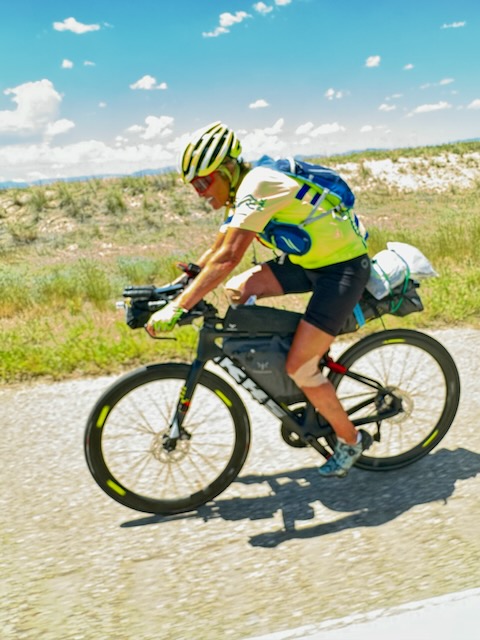
In March, I chatted with Leah Goldstein about her 2021 Race Across America (RAAM) win and asked about her bucket list (read the interview here). She alluded to the Trans Am race but didn’t let on that plans were already in the works.
Leah recently placed 3rd overall and 1st female rider to finish the race. She conquered the grueling 4,200 miles and 183,920 feet of elevation gain in just 22 days, 3 hours, and 2 minutes. The winner was just 21 years old, and second place was 24. She could easily be their mother’s age.
I was on the edge of my seat as Leah recounted her 2024 Trans Am experience, lessons learned, and mechanical issues. The combination of her Israeli special forces training and a “never give up” attitude helped her persevere through extreme conditions, including sleep deprivation, intense heat, torrential rain, encounters with aggressive dogs, and even a charging bear.
Enjoy the read and then go out and enjoy a ride.
Sheri: For RAAM, you had a team taking care of everything so that you could focus on riding. But with the Trans Am, it’s different that it’s a self-supported race. In the context of the Trans Am race, explain what it means to be self-supported.
Leah: For RAAM, I have a crew of nine people who are responsible for navigation, food, my bike change, mechanical issues, anything right for my well-being, and pushing me. But for Trans Am, I can’t get any help from anyone I know. So, no one who knows me can help me buy food, navigation, or anything. Let’s say I have a mechanical, I have to figure it out or call a bike store. I need the knowledge to fix it myself, just like with food. It’s primarily gas station food, or you get a Subway or McDonald’s, which is hard for me because I’m vegan. It was horrible. You know, I think I had the worst diet ever. It was tough.
Then I had navigation issues. I went off course a couple of times. Well, a lot of times. My Garmin wouldn’t acquire satellite because I was in a bad spot. Also, just keeping my devices charged was another challenging issue.
Sheri: So, you had to rely on the kindness of strangers?
Leah: Exactly, yes. It’s not always easy because sometimes you’re stuck in the middle of the night, and no strangers are around.
Sheri: Give me a rundown on your equipment setup and what you carried on your bike.
Leah: This was my first time doing an unsupported race, so I completely over packed. I think my bike probably weighed about 5 lbs heavier than everyone else. I was kind of afraid of the distance and cold. Even though I live in Canada, I’m really not good in the cold. So, I overpacked the jackets.
And of course, I don’t carry any cooking supplies, a tent, or a sleeping bag ― nothing, because my idea was just to sleep in a bivvy, like a large garbage bag. It’s designed to sleep in an emergency. I expected to sleep in churches and motels.
I packed all my clothes, navigational gear, charging devices, food, and water on my bike — an additional 15 to 16 lbs. I came in 3rd overall, which wasn’t bad. If you look at the bikes of two guys who took 1st and 2nd, they carried half the weight. The first-place finisher was 21 years old, and the second place was 24. I think their combined ages still don’t match my age.
Sheri: Right! It just shows that as we get older, we’re smarter, do better with endurance distances, and have many more miles in the saddle.
Leah: I lost multiple days because of ignorance, not knowing my mechanics. I use Di2 electronic shifting, and I had so many mechanical issues that, really, if I had understood the system, I could have fixed it on the spot. But, instead, I wasted time.
One day, I spent eight hours sitting in a bike shop for these mechanics, trying to figure it out. It was just simply a disconnected wire. It happened when my brake fell off cause the roads were quite rough. The bike takes a beating. My shifter and brake fell off, and when my brake fell off, it became unplugged from the Di2.
I lost all my shifting capacity. The ride to the next bike shop was about 15 hours. I had no break and no shifter for that duration. Think about how much time I lost, even with simple things like not using tubeless tires. I had about 12 punctures that could have easily been avoided using tubeless tires. Like a little thorn would cause a flat and I’m changing it. I was down to my last tube, which wasn’t seated properly, so I rode for 25 hours with a little bump. It was 25 hours before I found a mechanic who could adjust it.
Then, there was my tire selection. I chose the wrong tire. It was so tight that I had to use metal levers to take my tire off in Colorado. As a result, I cracked the wheel. Yeah, I cracked the carbon and rode with the cracked wheel from Colorado to Virginia.
I swear, anything that could go wrong in this race went wrong. Anything. And even being charged by a freaking bear, I mean, who gets charged by a bear?
Sheri: I read you had a close call with the bear. What happened?
Leah: Oh my gosh, I live in bear country. I’m from Canada. Bears are my neighbors, and they have never charged me. But I was in Kentucky, in the Appalachians. The climbs are insane. I was climbing this 14% grade, so I was out of the saddle with my head down. It’s like 3:00 in the morning.
There’s a dog issue there. You constantly get chased by dogs. I’m not kidding. Lots of pit bulls, and you name it right. Of course, you have pepper spray ― you have to. I had pepper spray latched to a pocket on my shoulder. When I saw this big black creature start running towards me, I said, “Oh crap, another dog.” I sat down and reached for my pepper spray. But behind the bear, an SUV crested the hill and he ran right into the bear. He purposely hit the bear because I didn’t even know it was a bear. But the guy in the truck saw that he was charging me, so he hit the bear so hard that it tumbled right over the cliff.
It was not a good scene, and I love animals. For me, it was disturbing. But once I realized it was a bear, my heart rate shot up to 3000. It was just crazy. I was shaken up. Then I remembered I had unclipped, and on a 14% grade, you’re not clipping back in again. I had to run up the rest of the way to thank the man. I don’t know what would have happened. My little pepper spray would have done jack for the bear.
But more than the bear, it was the dog issue. They said that there was big talk about the dangerous dogs in Kentucky. Actually, it was my most feared state, going through Kentucky. Because I kid you not, at one point, I had to ride with the pepper spray in my hand constantly. I couldn’t put it back in my pocket. I was being chased that often by really aggressive dogs. You’d be riding, and they would pop out of the bushes. At one point, I had to conserve my pepper spray. For some dogs, I would point it at them. I have a pretty good shot. And then I knew some of them would back off when they saw it. Obviously, they were sprayed before.
You have to conserve the pepper spray and say, well, if this dog bites me, how much will it hurt? It’ll really hurt, so I’m going to spray this dog. Then I thought, maybe if I changed my pattern and rode more at night, they wouldn’t be out. It was the same. I got chased through the whole state.
Kentucky was my most feared of all the ten states I’ve had to ride through. However, the drivers were more courteous and patient than any other place I’d ridden. When they passed, they would give me lots of room, and sometimes, going up these steep climbs, I would have six cars back and not one itty bitty honk. That was very impressive, and I would give the drivers an A. But not the dogs.
Sheri: Getting back to equipment. What bike did you use? What size tires?
Leah: I’m sponsored by KHS Bicycles, so I use their Flite racing bike with Kendal 30mm tires and tubes. This was a mistake; I should have gone tubeless. I had a regular road frame and added a time trial cockpit because I like to be more in the arrow position. I used a 12-speed Di2 and was afraid of using the electronic system because something might go wrong.
But people said if you don’t, your hands go numb. Even in RAAM, when I had manual shifting, I shifted with my whole arm because my hands stopped working cause of the pressure.
I have to be a little more knowledgeable about the system and how it works, and if something goes wrong, I know how to correct it. It isn’t that difficult. I have to spend time doing it.
Sheri: Bit of knowledge will go a long way for you.
Leah: Oh my gosh, it’ll go days. Next year, we will have a better plan. Also, knowing the course because there are many stretches where nothingness exists. You would have nothing for 100 -150 miles. No stores or anything. So, you have to ensure you are fully loaded with water, food, and whatever it may be in those sections. There are also a lot of sections with no reception, too. You have no connection for phone calls, so you have to rely almost on cars and whatnot.
On top of that, the weather was not our friend, and even when we came to Colorado, it hit 30-34 degrees Celsius (86 – 93 degrees F). And in Kansas, the highest temperature I rode was 110 degrees F. It was insane.
The heat was not terrible in RAAM because I had a crew of nine people who could cool me down. But when you’re on your own, all the water you have turns to tea in half an hour. And it’s boiling tea. At one point, coming into Missouri, I started knocking on people’s doors and asking them, “Can I buy some water off you or use your hose?” so I could spray myself off. It was really, really challenging with the weather, and it wasn’t just through that one state. It was hot right into Virginia.
Sheri: I was going to ask what the most grueling leg of the ride was.
Leah: Well, obviously, the Appalachians were insane. The climbs are one thing. You know they’re going to be tough, but dealing with climbs and heat simultaneously makes it even harder. I also think the weather in Kansas was the most challenging.
Sheri: How did you train differently for this event than for RAAM?
Leah: I trained with weight, even walking around. I’d wear a 15 LB vest. It’s like what bodybuilders use or people training for hiking trips. I always wore that whenever possible. And then, even when I rode, I always made sure that I had an additional 5 to 6 pounds in addition to what I was going to race with.
Gradually, I got my body used to the weight to avoid any knee issues or whatnot since I was not used to carrying that much weight for that distance. I also did practice races, replicating a three-day ride on my own. It is similar to RAAM training but with added weight.
Sheri: You alluded to it earlier that you struggled with navigation. What was happening with your Garmin?
Leah: Well, for one, I’m a terrible navigator. I’m surprised he didn’t end up in Alaska. When I told people in my circle about Trans Am, they said, “Oh, how are you going navigate it? You know you’re never going make it.” They know me.
I don’t often use devices like a Garmin. I don’t have to with RAAM. You don’t have to worry about anything. You sit on a bike, look at the road, and keep going. You don’t get off. But with this race, you have to worry about everything. I had to learn how to use my Garmin. And there were many things I didn’t know about it. Even RideWithGPS on the phone.
It reminds me of the first day of the race when a crazy storm hit us just as the race started. Winds of 70 KPH (43.5 MPH) blew me off the bike. At one point descending, my phone fell out of its holder, which is vital for my communication. Now I have no phone. At the bottom of the hill, I brake hard, skid, and almost crashed. I had to run back up the hill, and it took me two hours to find my phone.
It was sitting in a pile of mud and had water damage. For three days I had no phone, no communication. I just had the tracker. I had a spare phone, but it had nothing downloaded on it, just a small little junkie spare phone that I had just in case.
On day one, that’s when my troubles started until the phone dried out. It had a six-hour battery life, and then it would die. Also, on the first day, at 2:00 a.m., I had my first puncture. I couldn’t see anything. Pouring rain. I had to walk about four or five miles, and there was a motel. I rented a room for an hour and a half just so I could dry everything off and change my tire properly. It was just my inexperience ― such a rookie wasting so much time with stupidness. It caused me to lose so much time. I was expecting to ride that course much faster than I did.
Sheri: Well, you’ve gone through everything and learned a lot so that you can go faster next time.
Leah: I have so many notes. No surprises next time. I know that course like the back of my hand. I know exactly where I messed up. Knowing the course mentally, you know where you can go faster just by knowing what’s coming up. Right. But when you don’t, then you’re at that much of a disadvantage.
Sheri: On such a long race, how do you keep your GPS, lights, phone, and electronic shifting all charged?
Leah: The plan for the first day was to go through the night ride straight through as much as I could. Then, starting from the second night, take three hours of sleep and, if possible, in motels. If there is no motel, sometimes there’s a post office, or anywhere you can plug your devices. I also used battery packs. I had two Garmin head units that lasted about 17 hours.
I use the Dynamo hub for my front light since it generates electricity from the bike. It’s not ideal because it also takes a lot of watts. It’s ideal to first use rechargeable lights, and then, if that kicks it out, go to the Dynamo hub.
Most of my backlights were battery-operated, the little coin ones. They would last 60 hours. It was just a matter of changing the batteries real quick. For the most part, it was finding motels when possible. And then I could charge my devices.
Near the end, my stuff started to die. But I could always find an outlet like a Starbucks or beg somebody to use theirs.
Sheri: Everyone started in Astoria, OR, and then there were two finish locations. I understand that the route to DC mostly used rails to trails, but you chose the one that went to Yorktown.
Leah: It’s two different races. We just started at the same time. The one to DC is a little bit shorter and has a lot of gravel, so you need a different bike. There’s no way I could have done it on my bike.
Sheri: Hindsight is 20/20, what would you have done differently?
Leah: Everything. I took way too much stuff and also took, for example, something stupid. It’s like I had a pair of mitts because, through Colorado and Montana, it gets really cold. You’re hitting 11 degrees C at 1000 feet, and then I’m still carrying all that stuff through Kansas and into Virginia. Once I realized I was carrying all this extra crap, I just chucked it at the end. For next time, I’m going to take stuff that I can throw or give away.
Little things like that could save me an extra 1 or 2 lbs. It doesn’t sound a lot, but when you’re climbing a 19% grade for 10 kilometers or, 8 miles, it makes a huge difference.
Sheri: Registration for Trans Am 2025 is open. Did you register?
Leah: I didn’t know it was open so early. I guess I have to register when we finish our interview. I know I can ride faster because I can’t walk for a week when I finish RAAM. I kid you not like I’m crawling. After this race, I was physically fine. I was mentally really tired. Try sleeping three hours a day for three weeks straight. Even less than that, I started cutting my sleep even more because I was losing so much time. But I was back on my bike riding within a week after Trans Am, just not riding very fast.
I also think I was so afraid of the distance and being really too conservative. I know I can push myself a lot harder.
Sheri: While you were racing the Trans Am, Lael Wilcox was – and still is—on her ride around the world. Do you have any interest in taking on such a challenge?
Leah: I don’t know. After I won RAAM, I was interviewed by somebody who does self-supported races. They asked if I’d ever do Trans Am. I said I would never do that race in a million freaking years. I couldn’t imagine doing what I just did without my crew.
So, never say never. Right now, I’ll say no. It doesn’t interest me.
At the end of our conversation, Leah mentioned she’ll be working closely with her mechanic so that next year, she can troubleshoot any mechanical that gets thrown her way.
Hopefully, I’ll be able to ride part of the Illinois section with her next year – however, I won’t be assisting her. I may have a fighting chance to keep up with Leah since her bike will be loaded down with gear.
As initially seen on Road Bike Rider.
 Sunflowers and Pedals