
With origins in late 19th century France, Randonneuring grew out of interest in touring the countryside by bicycle. It is a long-distance cycling sport where riders attempt courses of 100K with options of 200K+, passing through predetermined “controls” (checkpoints). Riders aim to complete the course within specified time limits and receive equal recognition regardless of their finishing order. Riders may travel in groups or alone and are expected to be self-sufficient between controls. Randonneuring events can be ridden on paved, gravel, or mixed surfaces. Randonneurs USA (RUSA), the national body that sanctions randonneuring in the US, introduced a new gravel program in 2022.
You might have heard of one of the most famous randonneuring event (rando for short), Paris-Brest-Paris, or “PBP.” First run in 1891, the 1200K (745 miles) PBP is a grueling test of endurance and cycling ability, with a 90-hour time limit. It is considered the Olympics of cycling and is held every 4 years. The next one is in August 2027.
To put it in perspective, based on the success of PBP, the Tour de France started in 1903, after the first PBP. Originally, anyone could participate in PBP, but the rules changed in 1951 to only allow amateur cyclists.
My friend Dawn Piech is very active in the rando scene, a PBP finisher, and a RUSA board member. She’s always encouraging cyclists to join her for a rando event along with “Big Mama,” her Surley Moonlander fat bike. Yes, Dawn will ride Big Mama 200K+.
Dawn knew I’d been kicking around the idea of joining a rando ride to challenge myself. In addition, it’s the same reason I gravitate to gravel – the vibe. Rando riders exude a friendly, non-competitive camaraderie. I took the plunge and joined RUSA, paying $30 to the non-profit for a yearly membership.
Dipping My Toe (Cleat) in the Rando Pool
The first Saturday in April was a different kind of rando event. It was called a RUSA DART Populaire, 8-hour 120K Team Journey. The Chicago Randonneurs, the newest and fastest-growing region in Randonneurs USA, hosted the event. Sarah Rice, the Regional Brevet Administrator, leads Chicago Randonneurs.
Generally, participation is for individuals in a rando, but this was a team event. The rules are relatively simple:
- Five teams will start the event at 8:15 am at the Journeyman statue in front of Two Brothers Roundhouse in Aurora, Illinois.
- Teams consist of 3-5 bikes. At least three bikes from a team must finish together before the time cutoff of 8 hours (4:15 pm) for the team/riders to be considered official finishers.
- The final 25k must be ridden in the final two hours. That means every team must wait to leave their final control (Yorkville) until 2:15 pm. It’s okay if a team doesn’t reach Yorkville by 2:15 pm as long as they finish in Aurora by 4:15.
- Before the event, teams selected from five routes and received a GPS file. Dawn was our captain, and I warned her that the forecast was for strong northerly winds. She ignored my warning and chose the north/south loop!
As we gathered by the Journeyman statue, I saw some familiar faces. The bikes varied, with one team having a tandem. There were five of us rando first-timers. However, as with many cycling events and races, women were in the minority. There were only six women out of five teams, with our team contributing three of those women. RUSA boasts over 3,100 members, with only 17% of the members being women. Interestingly, the mean member age is 53 years young.
At exactly 8:15 am, in cloudy, blustery weather, we all hit start on our GPS and pedaled off in different directions. We rode with another group for about five miles before they split off on their route. Dawn, Hollie, and I headed to Morris, Illinois, directly south of the start.

For 31 miles, we enjoyed quiet country roads and a bit of a tailwind until our first stop at a Pilot gas station in Morris. A quick break for a control photo, which is proof of passage stop in randonneuring. Plus, much needed nutrition and a nature break before heading north and west into a 20 mph headwind! What the route lacked in elevation gain, it made up for it with head and crosswinds. I teased Captain Dawn that this faux pas would cost her points on my Yelp review.
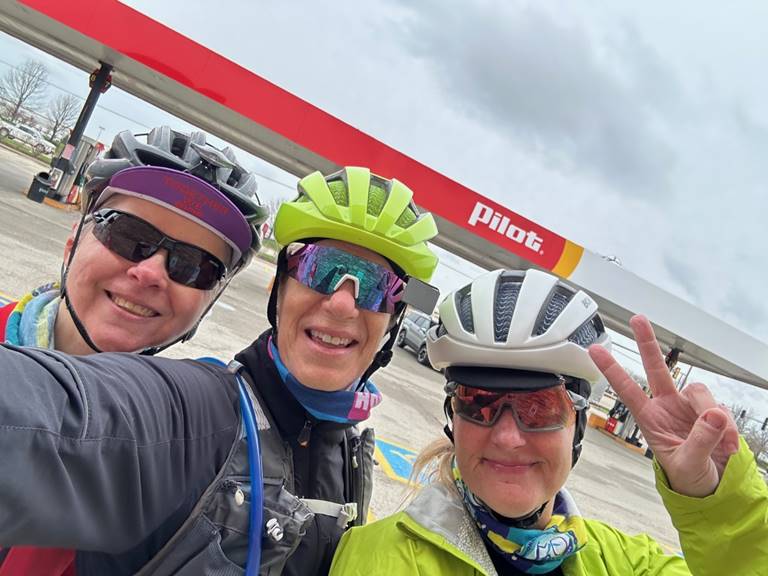
The next photo control was an intersection in the middle of nowhere and was a street sign. We made it to Yorkville as the teams began to converge at the local pizza and smoothie restaurants. Forty-five minutes before the scheduled departure, we had time to socialize with the other riders. Then, at 2:15 pm, everyone departed Yorkville together for the 25K back to Aurora, following the French team rules for a DART team event.

All the teams made it back to Aurora before the 4:15 pm cutoff, and to bring this full circle, we took pictures in front of the Journeyman statue. To underline the camaraderie of randonneuring, the event organizer asked if a team finished early to stay around until 4:15 pm and welcome all the finishers.

After the ride, everyone stayed for food and drinks at Two Brothers to swap stories of their randonneuring adventures. I enjoyed the event and working as a team. Yes, I’m eager to ride another rando, but I think 200k-250k will be my maximum distance.
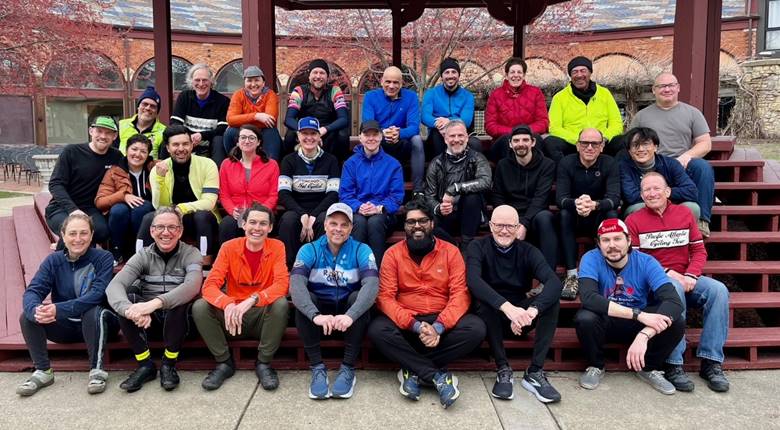
Interested in trying a rando event? There are 53 chapters all over the US, as well as International sanctioning organizations (i.e., Randonneurs Mondiaux) that hold events all over the world. Try one near your home, or make it a destination cycling adventure event.
Resources:
Randonneurs USA Geosearch Resource
The Five Myths About Randonneuring
As initially published on RoadBikeRider.com
 Sunflowers and Pedals